
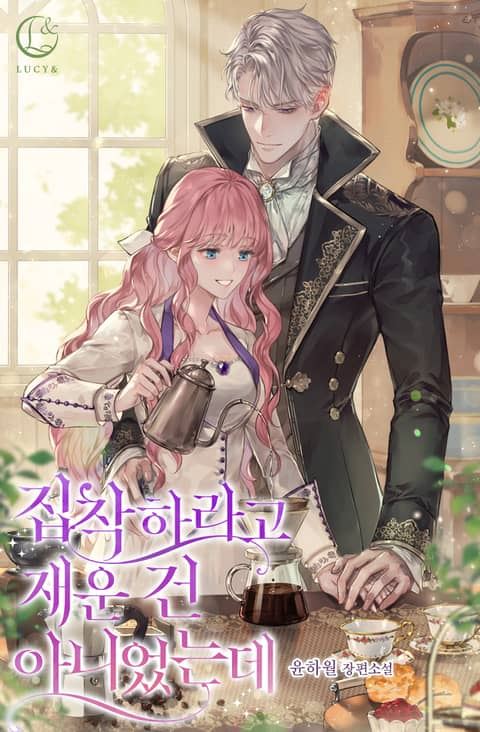
“I’m going to live here with sister!”
She possessed a supporting role, who was swayed by the villain and killed by his male protagonist, Duke Claude Winterville. In addition, she accidentally picked up his nephew!
Furthermore…
“You better tell me the truth. How did you put me to sleep?”
Like in the original novel, her ability to heal Claude’s insomnia was revealed. In the end, she even received an offer as his exclusive barista to make’ sleeping coffee’ for him!
However, to avoid the death flag, she had to decline the offer—
“I’ll open up a cafe in the capital, and of course, the owner will be you, April.”
As expected, the best treatment is financial treatment.
“I’ll do it!”
She accepted the offer, blinded by her dream of opening her own cafe.
She was just trying to help him sleep well and only took Claude’s hand because of the beneficial offer… but, why did he suddenly get obsessed?
“I won’t let you regret your decision.”
Somehow, his gaze looked unusual.

Popular Reviews
In my opinion, this work deserves more than full marks—call it an 11 out of 10, 6 stars out of 5, or Rank S! Drawing from real-life scenarios, it addresses intersexuality with remarkable sensitivity, shedding light on the challenges, struggles, and emotional pain experienced by those born as intersex individuals and navigating life as such.
It's an exceptional read, and I sincerely hope you feel the same way.
I've completely fallen in love with the series and its characters. I really admire Haru.
I highly recommend this series. While the art can seem a bit odd at times, it's definitely worth it. The entire series is fantastic, and I would strongly suggest it to anyone interested in exploring themes of gender identity.
Story: The first volume consists of short stories, while the rest focuses on Haru's story. Although you won't find an extremely intricate plot (keep in mind, this is a shoujo manga), the various events that alter the characters' lives and personalities are highly original and refreshing. The narration is particularly interesting as it switches perspectives back and forth between the main character and their friends, relatives, and even strangers they encounter.
Art: Classic shoujo manga art. The artwork is very modest (nothing flashy) but carries its own charm and cuteness when necessary.
Characters: This is the strongest aspect of the series. The characterization of Haru is outstanding. Combining both male and female traits has created one of the most unique characters I've encountered in shoujo manga. Additionally, we witness the evolution and changes in the main character, as well as those close to them and their understanding of IS (intersexuals).
Enjoyment: I was going through a manga "dead-period" when I started reading this series, meaning I had significantly reduced my manga consumption for a few months. However, this series was so compelling that it brought me out of that phase. That should speak volumes.
Overall, this manga is truly impressive and moving. At certain points, I was almost moved to tears. This is the first review I've written because too few people have read this manga (and didn't give it high ratings), and I feel compelled to promote such an incredible work.
However, if you feel uncomfortable with this manga, then you may not be open-minded enough yet. Intersexuals occur at a prevalence of up to 0.1% or 0.01%, depending on the definition. This means one in 1000 to one in 10,000 individuals are born intersexual. It is just as wrong to discriminate against intersexuals as it is to discriminate against males or females.
The initial volume begins with a series of short stories, giving insight into the struggles intersex children face while growing up. There are people in the world who don't understand intersexuality or the complexities of raising 'different' or special-needs children. Additionally, there's the burden on parents making life-altering decisions for their children, impacting not only their own lives but also shaping their children's futures and mindsets.
This portrayal is deeply touching. While some aspects may not be entirely factual despite evident research, the manga effectively conveys the hardships experienced by families with intersex children as they mature. This leads us to Haru's storyline and the characters.
The remainder of the manga follows Haru's journey. We witness how Haru's parents choose to raise him and the impact of being intersex on his life. The narrative is profoundly moving and cleverly crafted, weaving romance, love, pain, and suffering into an almost flawless story. The character development in this series is exceptional.
The characters are the backbone of this manga/series. They are compelling and intriguing, drawing you further into the story as you yearn to discover their fates. Whether the intersex children decide to identify as male or female, and how those around them react—be it teasing, cruel, misunderstanding, or kind and friendly—all add layers to the narrative.
The artwork is straightforward and clean, though shading and tone can occasionally appear messy or awkward, which isn't unusual for shoujo manga. The characters are simple yet distinct, and their transformations are visually noticeable, complementing their evolving personalities beyond mere dialogue.
I would recommend this manga to anyone with an open mind and the ability to empathize with the reality that many people are different—not necessarily by choice. This manga was incredibly touching and an extraordinary read.
<p>
IS: Otoko demo Onna demo Nai Sei is a manga consisting of three separate stories, the first two being only six chapters each and the last one taking up the majority of the manga. This last story is by far the best and the only one I will discuss in this review. To me, volume 2 (chapter 13) is where the actual story begins, so if you start at the beginning and aren't really feeling it, I'd recommend just skipping volume one as it has no impact on the rest of the story.
So, how is the story? Well, it's fantastic and very engaging. Haru is an excellent protagonist, and you genuinely empathize with him throughout the story. We follow him from birth all the way to early adulthood, and his character development, along with that of many side characters, is so well done that it deserves recognition. The art style is standard shoujo, nothing extraordinary but effective. Character design is decent, which I don't mind as long as they look distinct enough from each other, which they do. The drama is great and almost brought me to tears at times, and the story itself is deeply moving. So why do I have mixed feelings about it?
The pacing. For the first 30-40 chapters, the story moves at a great pace, but then we get stuck in "almost-filler-land" for what feels like forever. Basically, most chapters take place from a single character's viewpoint, and that character is often the main character, Haru. Now, as I said, Haru is great, and there are several other characters who are also great, but at some point, the author decided that every single minor character needed their own chapter, their own issues, their own tragic backstory, and it completely disrupts the flow of the story. You're so invested in it, and then suddenly it feels like half the chapters become unnecessary side-story filler about people you aren't that invested in.
What makes it worse is how formulaic it eventually becomes. I wasn't exactly counting, but it felt like there were at least 15 chapters in this manga that all followed the exact same formula. We get to know some minor character, they have it rough for some reason (boyfriend only wants sex, rough family life, is bullied, can't stand up for themselves, dead mom, etc.), then they meet Haru, are sometimes mean to him at first but he just takes their abuse and then calmly relates their problem to his own, tells some personal story about his life, and then gives a motivational speech which makes them respect him/feel better. Not only does this get extremely repetitive, but it also makes Haru seem really one-dimensional when we know he isn't.
The problem is that these chapters are split up so you don't get them all in a row, and while some of them really could be skipped without missing anything significant, others cannot, so you need to read it all unless you want to risk becoming confused later. For the record, I'm not saying all of these chapters are bad; they just feel like they're interrupting the flow of the story, and all I could think while reading some of them was that I wanted to get back to following Haru and his journey.
Eventually, the story more or less gets back on track and from that point on it's pretty good again all the way to the end, which I liked well enough, although I was kind of hoping for a bit more (that could very well just be my preference though).
Overall, IS: Otoko demo Onna demo Nai Sei is a fantastic manga plagued by some puzzling pacing decisions here and there. If I could judge only the good parts, this would be a 9, but as a whole, it's probably closer to a 7.
That said, when it's good, it's really good, and I'm glad I read it.
I.S. initially caught my attention because, honestly, how many manga out there focus on intersex individuals? As a fan of Hourou Musuko and a few others that explore gender identity and sexual orientation, I was thrilled to discover this one and immediately set out to find it.
If this were a review solely of the first story, Case 1, I would rate it as follows:
Story: 9
It's brief but incredibly heartfelt. Despite the rough translations, I genuinely connected with the protagonist, Hiromi. There were moments that nearly brought me to tears. While character development was limited, Hiromi was developed enough to make the story enjoyable.
Art: 9
The artwork remains consistent throughout the series, charming and visually appealing. It’s clean and well-executed.
Character: 8
I wished for more depth in the supporting characters, but given it's a one-shot, Hiromi stood out as strong, determined, and believable. His decisions felt logical within the context of his situation.
Enjoyment: 10
Isn't it obvious by now that I absolutely adore the Case 1 one-shot?
Overall: 9
A nine because of some casual averaging. I appreciate how real-world issues are addressed.
Moving on to Case 2, it felt somewhat repetitive. Perhaps reading it all at once wasn’t the best idea. The protagonist's repetition made me lose interest, though I stayed engaged due to subtle differences in the protagonist and the greater contrast among those around her.
Now, onto Case 3, which is the primary focus of this review. Here, our protagonist is Haru. Raised as intersex rather than male or female, and using female pronouns for much of the story while identifying more as male before switching to male pronouns. For the remainder of this review, I'll use male pronouns.
Story: 6
The opening was fascinating, offering insight into the parents' perspective. Deciding how to raise an intersex child—whether to force surgery on an infant, let them decide later despite potential social ostracism, considering the child's health and happiness—all these questions are monumental for anyone raising an intersex child. The sections focusing on the parents and young Haru were excellent, fun, and believable.
However, once Haru reaches high school, the story weakens significantly. Over and over, Haru can't seem to think about anything other than being intersex. Understandably, such concerns weigh heavily if one fears judgment, but almost every page of Case 3 reiterates, "I am intersex. I accept that I am intersex. I must educate about intersex. It's okay to be intersex." Every. Single. Page. It's fine acknowledging your intersexuality; accepting your body and promoting awareness are commendable. Hiromi and the protagonist from Case 2 also educated others. People need that guidance. Still, when every page mentions "I.S." multiple times, it grows tiresome. I appreciated moments where Haru focused on something else, like romantic feelings or interactions with his best friend—they provided refreshing variety.
When the narrative switches perspectives, it often feels invigorating—unless the new viewpoint fixates solely on Haru's intersexuality, making it redundant. In short, the story stagnated, revisiting the same points endlessly.
Art: 9
As previously mentioned, the art is delightful and aesthetically pleasing.
Character: 7
Initially, Haru and his family's development were compelling as you witness him growing into what seemed like a resilient character navigating gender identity, puberty, and other challenges. He reflects on his intersexuality during relevant developmental milestones, which works initially. However, this theme drags on excessively, losing impact and becoming monotonous. I found myself eagerly clicking through pages hoping for novelty.
Miwako deserves mention here. She undergoes significant development in just a few chapters, surpassing Haru's growth across several volumes. Unlike Haru, who always knew he was intersex, Miwako was raised as a girl, unaware of surgeries performed without her knowledge or consent. Upon discovering the truth, she felt betrayed and lost trust in her parents. Her journey from deep depression to acceptance was condensed yet impactful, avoiding the prolonged repetition that plagued Haru's arc.
Enjoyment: 5
Repetitive content and constant reminders about accepting intersex individuals (preaching to the choir) dulled my experience. What could have been moving became numbing, leaving me disengaged from characters I once thought might elicit tears. At this point, I continue reading only in hope of something remarkable.
In summary, Case 1 is excellent, Case 2 is decent, and Case 3 is progressively disappointing. If you enjoy reading the same message repeatedly or appreciate characters whose development stalls until it loses meaning, you'll love Case 3. Otherwise, stick with Case 1, perhaps Case 2, and only approach Case 3 if bored and curious about exemplary parenting examples.
Oh, and nearly everyone in this manga cries an awful lot—seriously, a LOT.
Note: If anyone finds my terminology offensive, please message me so I can correct it. I strive to avoid unintentional offense but recognize occasional missteps despite good intentions.
For instance, a character quitting their job was a straightforward resolution without the typical hero or main lead (ML) rescuing them, which I appreciate. The MC-ML relationship stands out as refreshingly authentic; they haven't shown signs of instant attraction or possessiveness, which keeps things intriguing.
What's impressive is how both the MC and ML exhibit maturity, especially when it comes to their interactions. When the MC initially hesitated to join them, the ML offered to invest in her capital shop rather than resorting to emotional manipulation. Similarly, when he insisted on having the MC at the imperial palace for the child's emotional support, despite his own claims of not needing affection, it showcased his considerate nature.
Overall, I appreciate the理智 and genuine portrayal of the characters, and I hope this balance continues throughout the story. It would be fantastic to see more MLs who prioritize reason and empathy over manipulative tactics.
Leave a Review
Part 1. Rate (click Star to vote)
Part 2. Login to account
Part 3. Write your review
Directory of Novels. where you can find Novels
Copyright novel cool © 2018–2024 — All rights reserved